Latest & Archived Blogs

We were recently joined for a fortnight by Stephanie Bredbenner, a student undertaking the Masters degree in Archives and Records Management at the University of Liverpool. As well as producing an excellent catalogue of W.P. Crozier’s Foreign Affairs Correspondence in the Guardian Archive, Stephanie found time to write a blog post for us before she left:

During the first two weeks of January, I worked on cataloguing the ‘confidential correspondence’ series of W.P. Crozier (1879-1944), editor of the Manchester Guardian from 1932 to 1944. The series is incredibly rich in materials from the Second World War on topics as diverse as confidential military and diplomatic strategy, the Blitz, and censorship of the British press. The most abundant materials concern the Middle East, particularly Palestine. Like his mentor C.P. Scott, Crozier was a fervent Zionist, and much of the correspondence concerns the Zionist movement and efforts to establish a Jewish national home and a Jewish fighting force during the war. The series provides valuable insights into the crucial role the Manchester Guardian played in the Zionist movement.
 

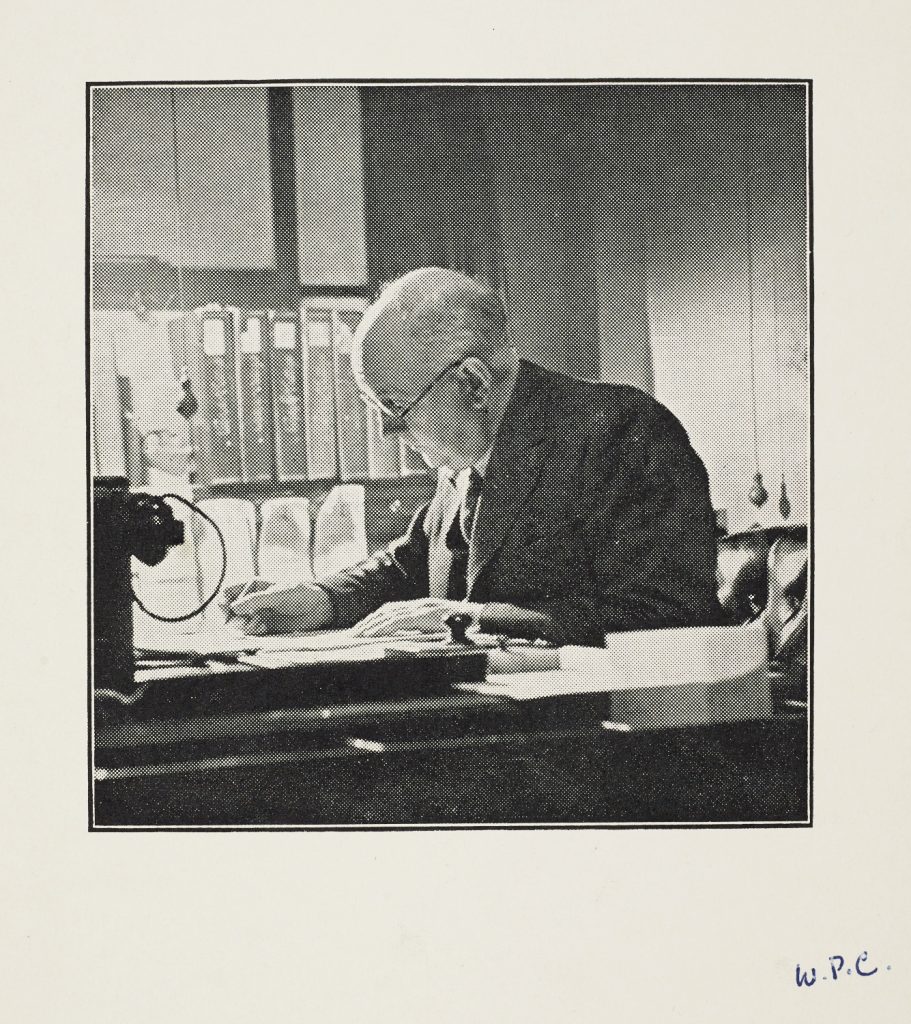
W.P. Crozier sat writing at a desk.

W.P. Crozier in the office.
 
C.P. Scott, editor of the Manchester Guardian from 1872 to 1929, became a crucial ally to Jewish academics who settled in Manchester and made the city the centre of British Zionism. Scott was the founding member of the British-Palestine Committee and along with Manchester Guardian staff members Harry Sacher and W.P. Crozier, became a committed Zionist. He befriended Chaim Weizmann, Reader in Chemistry at the University of Manchester and leader of British Zionism who later became the first President of Israel. Scott used his influence at the Manchester Guardian to elevate the profile of the Zionist cause. He was also instrumental in introducing Weizmann to powerful figures such as David Lloyd George, Herbert Samuel, and Arthur Balfour, 1st Earl of Balfour, who later cemented British support for a Jewish national home with the Balfour Declaration of 1917.
 
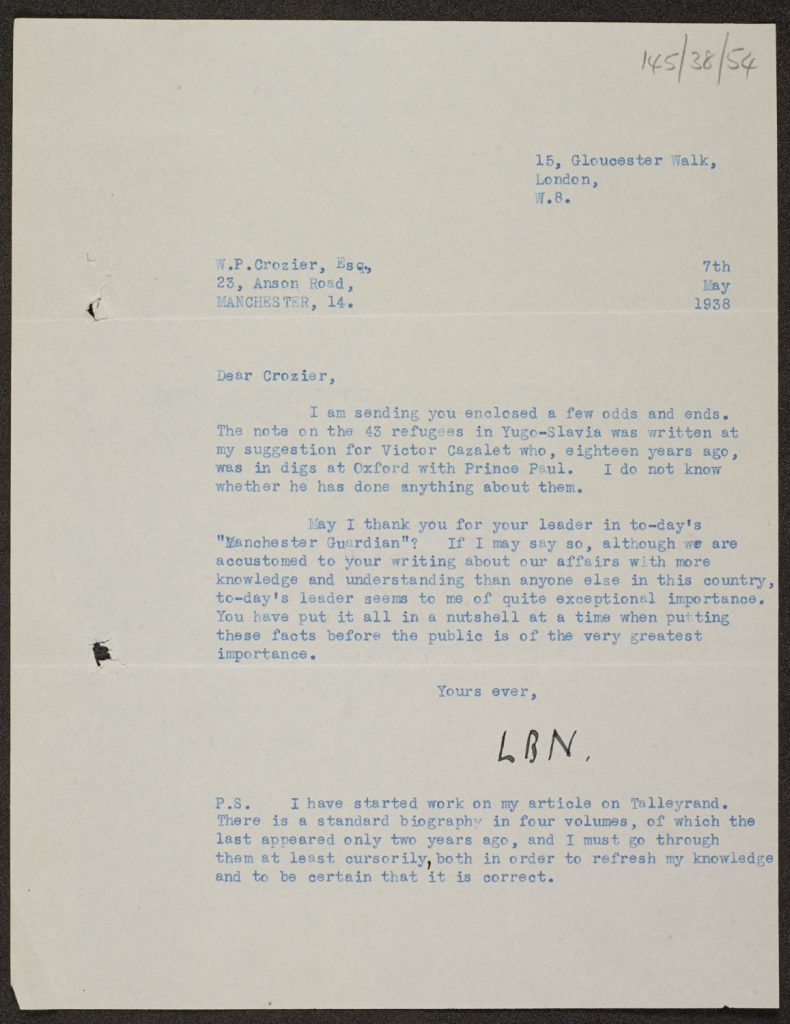
Crozier continued Scott’s legacy by advocating for a Jewish state both inside and outside the pages of the Manchester Guardian. His primary correspondent on Zionist issues was Sir Lewis Bernstein Namier, a renowned Jewish historian who was a professor at the University of Manchester. Namier, once the secretary of the Jewish Agency for Palestine and a life-long Zionist, frequently sent bundles of documents for Crozier’s information and use. Crozier then used his influence in the British press to provide incisive commentary on the Zionist struggle. Crozier himself continued to write articles on the subject in addition to his editorial duties, demonstrating his passion and knowledge about Zionist issues. The importance of Crozier’s coverage of the Zionist cause was praised in a letter from Namier, dated 7 May 1938. Namier wrote:
 
‘May I thank you for your leader in to-day’s “Manchester Guardian”? If I may say so, although we are accustomed to your writing about our affairs with more knowledge and understanding than anyone else in this country, to-day’s leader seems to me of quite exceptional importance. You have put it all in a nutshell at a time when putting these facts before the public is of the very greatest importance.’
 

Letter from Lewis Namier to W.P. Crozier

Letter from Lewis Namier to W.P. Crozier
 
Zionists like Namier and Weizmann, both academics at the University of Manchester for decades, used Manchester as a centre for their activities. The Crozier confidential correspondence series contains significant materials which were circulated throughout the British Zionist network in Manchester. Crozier was influential in tapping into Zionist information networks and disseminating their impassioned pleas to the public. Crozier’s confidential correspondence provides insight into the behind the scenes machinations and carefully constructed rhetoric of the Zionist movement. Namier often sent Crozier initial drafts of crucial speeches, reports, and correspondence in addition to the final draft, showing a long and careful process of revision and negotiation within the movement. Crozier often saved multiple drafts of the same document, along with notes from Namier and himself. Such delicate diplomatic negotiations are displayed in one 1941 letter from Chaim Weizmann to Prime Minister Sir Winston Churchill, of which Crozier saved multiple drafts. Weizmann wrote:
 
‘Tortured by Hitler as no nation has ever been in modern times, and advertised by him as his foremost enemy, we are refused by those who fight him for the chance of seeing our name and our flag appear among those arrayed against him. I know that this exclusion is not in your own intentions or spirit…But are the Jews so utterly unimportant as the treatment meted out to them suggests? … You are dealing with human beings, with flesh and blood, and the most elementary feeling of self-respect sets limits to service, however willing, if the response is nothing but rebuffs and humiliations. Let me feel, Mr. Prime Minister, that our friendship is not spurned on the British side, nor our name obliterated at a time when Hitler is endeavouring to obliterate our very existence.’
 
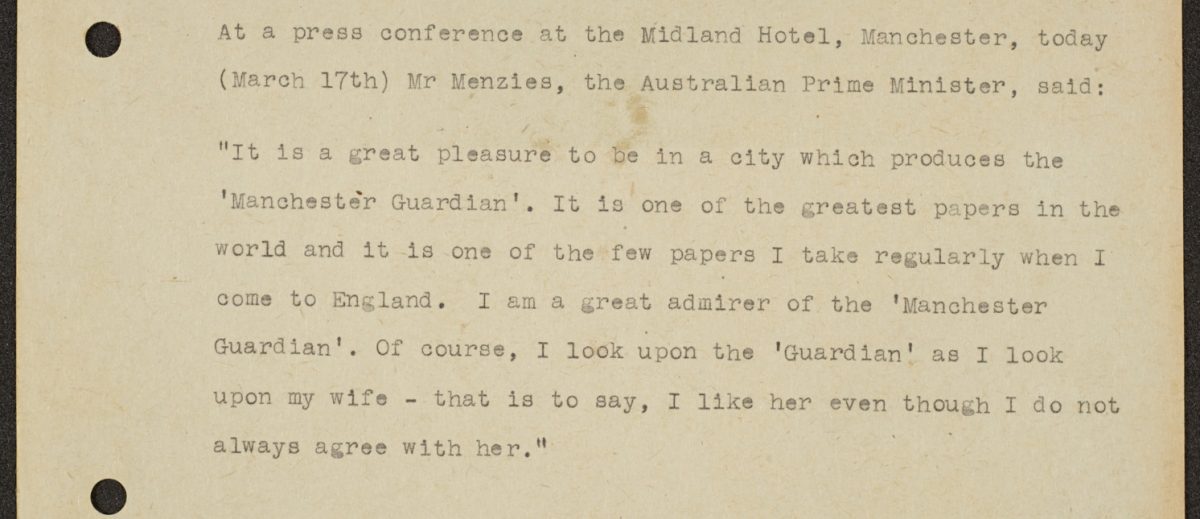
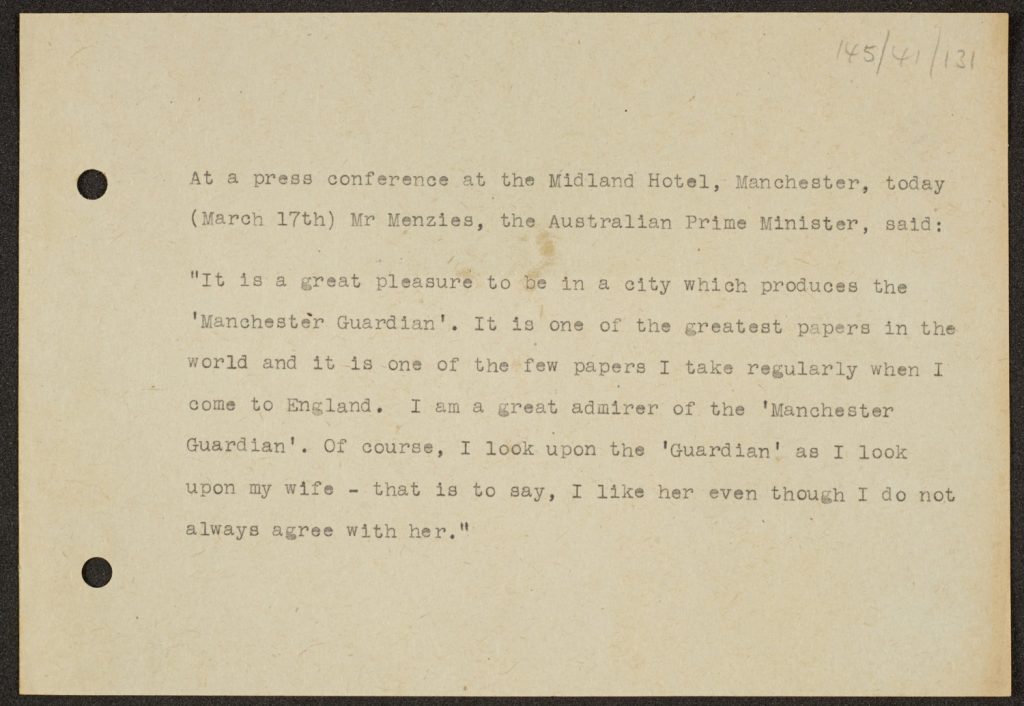
The Manchester Guardian was one of the most prominent newspapers on the global stage espousing Zionist ideals. The impact of Crozier’s efforts to raise the international profile of the Zionist cause by leveraging the reputation of the Manchester Guardian is perhaps best expressed in this statement made by Robert Menzies, the Prime Minister of Australia, upon a visit to Manchester in 1941:
 

Memo quoting a statement by the Australian Prime Minister Sir Robert Menzies.

Memo quoting the Australian Prime Minister Sir Robert Menzies.
 
In addition to his involvement in British Zionism, Crozier collected correspondence relating to Zionism and the fate of Jewish refugees all over the world, including in Palestine, Iraq, Mauritius, South Africa, Turkey, and the United States. Until his death on 16 April 1944, Crozier continued collecting information and writing about liberated concentration camps and the Zionist cause.
 
All images in this post are reproduced courtesy of Guardian News and Media Ltd.
 

Denis MacEoin

With the advent of a new US administration in January 2017, massive changes are expected, not just on the domestic front, but internationally. One of the first regions that will require immediate attention is the Middle East, where the policies of the Obama administration have led to a diminished role for the United States. Syria is certain to be the main focus of concern, bringing together a hideous network of interests, counter-interests, and Gordian knots involving Bashar al-Assad’s “Syrian State”, Vladimir Putin’s Russia, Iran’s Hezbollah, Iran’s Revolutionary Guard Corps, several rebel groups with links to al-Qa’ida, and hundreds of others. (For a remarkable list of armed groups in Syria, see here.)
 
More or less simultaneously, the State Department will have its hands full with Iran, the PCPOA nuclear deal, a crisis over renewed sanctions for which Congress voted overwhelmingly on December first, and the continuing role of the Islamic Republic in fostering, funding, arming, and providing armed forces for terrorism in Yemen, Syria, Gaza and Lebanon.
 
The United States is still invested in Iraq and Libya and needs to keep a watchful eye on Egypt, Turkey, and Afghanistan (where the Taliban are making a comeback), and a broader vision of further developments in the rise of Islamic extremism where it moves into Europe and North America with a possibly unprecedented increase in terrorist attacks.
 
Those issues alone should be enough to keep any president or secretary of state awake most nights, but they may not eclipse the longest-running crisis in the region – the pursuit of an ever-elusive peace between the people of Israel and the Palestinians. Over the eight years presided over by Barrack Obama, assisted by Hillary Clinton and John Kerry, the peace process (if we may call it that) has tilted seriously in what it would not be rash to term the wrong direction. Obama’s personal antipathy to the Jewish state (and to Prime Minister Binyamin Netanyahu) was given free rein alongside overt sympathy for the Muslim/Arab/Palestinian side. The Palestinian narrative came to dominate thinking in the US and Europe alike, with Israel being given short shrift in negotiations, op eds, and UN resolutions.
 
But things may be about to change. Former New York mayor Rudy Giuliani has been offered and has accepted the role of Secretary of State, and first indications are that he will reject some if not all of the Palestinian version of events and objectives. His closeness to Israel is well known. During the 2008 US presidential election, a group of eight Israeli experts declared him the best candidate for Israel. He recently stated “that the U.S. should oppose a two-state solution to the Israeli-Palestinian conflict until the Palestinians can prove they are capable of renouncing terror”.
 
If, as is expected, Trump appoints his son-in-law Jared Kushner to the role of a peace envoy to Israel, Giuliani will have someone on the ground to back up a shift from Obama’s pro-Palestinian position to a pro-Israel one. In one important respect, the myth of the illegality of Jewish settlements in the West Bank may now be discarded: Kushner is on record as having made financial donations to more than one settlement.
https://en.wikipedia.org/wiki/List_of_armed_groups_in_the_Syrian_Civil_
If the new administration intends to move towards Israel, it must at the same time move away from the Palestinians in a certain sense. Certainly, the US must start to apply greater pressure to bring the Palestinians towards the negotiation table. The PLO and Fatah at least, because Hamas remains fixated both on their brand of religious absolutism and the rejectionist assertions to be found in Article 13 of their 1988 Covenant:
 
Initiatives, and so-called peaceful solutions and international conferences, are in contradiction to the principles of the Islamic Resistance Movement…. Now and then the call goes out for the convening of an international conference to look for ways of solving the (Palestinian) question. Some accept, others reject the idea, for this or other reason, with one stipulation or more for consent to convening the conference and participating in it. Knowing the parties constituting the conference, their past and present attitudes towards Moslem problems, the Islamic Resistance Movement does not consider these conferences capable of realising the demands, restoring the rights or doing justice to the oppressed. These conferences are only ways of setting the infidels in the land of the Moslems as arbitraters.
 
There is no solution for the Palestinian question except through Jihad. Initiatives, proposals and international conferences are all a waste of time and vain endeavors.
 
With the prospect of a unity government between Gaza and the West Bank – a proposal advanced by the objurate PA president Mahmoud Abbas at Fatah’s November 2016 conference – that hardline attitude may be reinforced. After all, Fatah and the Palestinian Authority have themselves stayed away from negotiations for some years now, and Abbas is now consolidating his own power after purging Fatah of most of his previous opponents.
 
Given all this, there will be little time for Trump and Giuliani to move if they are to reverse the pro-Palestinian drift of recent years. If negotiations are to be resumed, however, they will be complex since opinions among both Israelis and Palestinians are mixed. But harder work will have to be done on the international scene, in the UN, with the Arab League and the Organization of Islamic Cooperation, and the many Western countries who have embraced the Palestinian narrative.
If the new administration is to make rapid progress in the peace process (to the extent there is one), their first priority must be to demolish the Palestinian narrative. It is a false narrative from beginning to end. It tells historical falsehoods about the origins of the “Palestinian” people, the precedence of Jews in the land, the Jewish and Christian identity of holy sites, and the self-inflicted Nakba of 1947-48. But a purely historical approach is unlikely to appeal on the political or emotional level. Something more has to be addressed. That something more must, I am convinced, be a hard-headed dismissal of the narrative of Palestinian victimhood. It is this perception of Palestinians as the constant victims of an aggressive Israel that drives pro-Palestinian Christians, human rights activists, moral campaigners, socialists, and many others.
The importance of a shift in narratives cannot be overemphasized. It is the key to peace. This is put very well by Moshe Arens: “Just as real peace could come to Europe after World War II only after Germans abandoned the ‘German narrative’ and accepted the true history of the war that Germany started, so only abandonment of the ‘Palestinian narrative’ and acceptance of the true sequence of the events of 1947-48 can serve as a basis for reconciliation between Jews and Arabs.”
 
The Palestinian Arabs, their leaders, and their manifold aiders and abettors worldwide have deluded the international media, the United Nations, politicians just about everywhere, religious leaders from most of the Christian churches, and human rights activists on every continent into believing them to be the world’s greatest victims, a struggling and persecuted people whose woes and sufferings have for decades eclipsed those of every other suffering minority on the planet’s face. You never have to look far for evidence of this.
Writing in 2015 shortly after Mahmoud Abbas’s visit to the UN General Assembly, Dr. Eran Lerman of the Begin-Sadat Center for Strategic Studies expressed this sense of Palestinian victimhood thus:
The speech delivered by Palestinian Authority leader Mahmoud Abbas at the UN General Assembly last week was proof, once again, that the Palestinian “narrative” of victimhood has become a threat to any practical prospect for peace. Palestinian leaders consistently advance an interpretation of history which is at odds not only with the facts but also with their people’s best interests.
At the core of Abbas’ (sic) plaintive narration is the notion of the Palestinians as innocent victims, whose right to statehood and independence has been taken away and brutally ignored for much too long. In this telling of history, the Palestinians deserve to be backed by coercive intervention, as soon as possible, so as to impose on Israel a solution which would implement their “rights.”
 
Lerman adds that “The false Palestinian narrative of one-sided victimhood is a major hindrance to all efforts in the direction of Israeli-Palestinian peace. Global actors need to help the Palestinians move beyond wallowing in self-pity and rituals of bashing Israel, and towards difficult compromises with Israel.
Writing on Honest Reporting in October 2016, Zahava Raymond speaks of an article in Ireland’s anti-Israel newspaper, the Irish Independent, promoting a photo exhibition entitled “This is Palestine” by choreographer and would-be Middle East authority John McColgan.
 
In the world of the Irish Independent and McColgan’s exhibition, every Palestinian is a victim of Israeli oppression. There are no Palestinians who harm other Palestinians, and there are no Palestinians who harm Israelis. It is the usual, one-sided, simplistic narrative that the media generally favor, where Israelis = oppressors and Palestinians = victims.
 
This trope of Palestinian victimhood is pretty well universal and is seldom resisted or exposed anywhere outside media and political circles unless they are pro-Israel or genuinely balanced. Whether it be the New York Times, The Guardian, The Independent, or a host of other media outlets in print or online, the Palestinian people are the world’s victims par excellence.
But it’s not just the media that think that way. Many Protestant churches across the world adopt the same attitude. Writing for Commentary two years ago, Melanie Phillips declared that “within the Protestant world, many churches are deeply hostile to the State of Israel. They present the Palestinians as victims of Israeli oppression while ignoring the murderous victimization of Israeli citizens at their hands.”
 
Psychologically, it is easier to embrace a good cause (or, for that matter, a bad one) in black and white terms. For many people on the left of politics, a good cause is made up of people who suffer from imperialism and colonialism, plucky minorities, third-world victims of first-world oppression, revolutionary vanguards, and anyone put upon by the United States, Great Britain, France or any former imperialist power. Among such groups, the Palestinians have the most to offer, being permanently “dispossessed” by, of all people, the Jews. But since the Jews themselves have suffered from dispossession a great deal longer than any other people on earth, the pro-Palestinian cause has to be the blackest and whitest of all. Any hint of gray, any introduction of counter-arguments, any presentation of different facts is anathema. Only the flat and unvarnished Palestinian “truth” must be permitted.
Here is where it gets tricky. It does not take much study to learn that the Palestinians have actually been responsible for a lot of bad things themselves, that innocent Jews have been victims of decades of Palestinian terrorism, and that things are far from being black and white. This means that supporters of the Palestinians have to create a narrative of their own or embrace one invented by Palestinian propagandists. On one hand, the Israelis (aka the Jews) must have done all the bad things that are thought to have taken place in the territory set aside by the League of Nations for the Palestine Mandate. And, on the other, nothing bad has ever been done by any Palestinian. The violence, the killings, the terrorism can only be from one side, the Israeli side, whereas the Palestinian Arabs have always been seen as the victims of Israeli barbarism and Jewish ill will.
This one-sided concern to absolve the Palestinians of their many sins and, what is worse, to offload those sins onto Jews and Israelis has many consequences. Perhaps the most serious of those is that Palestinians are deprived of any sense of agency. To be ever passive, to suffer and never act, to complain yet never offer positive suggestions for a way out of suffering in the end strips the Palestinians of any sense of agency.
 
To become agents of their own destiny, it is time for the Palestinians as a group and through their leadership to take action to resolve their internal difficulties and their engagement with the outside world. This will require a realism that has been absent from their lives for so long, a sense of purpose for an achievable goal (i.e. a state that does not demand the abolition of Israel), and a recognition of their own mistakes over many decades.
 
Palestinian refusal so far to do any of these things exposes a deep psychological problem, a problem that has trapped them in an endless round of violence and rejection. This rejectionism is entirely contradictory to their own best interests. People who suffer generally opt for solutions they are offered, even if acting on them involves some pain. Someone dying of cancer or diabetic complications will usually agree to a mastectomy or and amputation on the understanding that it will save their life. Someone with unmanageable debts will as often as not choose bankruptcy in order to set themselves back financially. The Palestinians have no hope of ever beating Israel so long as they cling to the old Khartoum formula of “no peace with Israel, no recognition of Israel, no negotiations with it.” Yet they have consistently refused to take the least action that might bring them better lives, regardless of how far it is obvious that Israel seeks a peaceful resolution of the conflict.
 
If Rudy Giuliani and the new US administration seek to advance the moribund “peace process”, they could find no better place to start than direct confrontation with Palestinian rejectionism. No-one wishes to see ordinary Palestinians suffer needlessly, but so long as their leaders persist in a preference for victimhood, that suffering will not be alieved. This means that those leaders must be pressed as hard as possible to end their persecution of their own populations. If necessary, Palestinians must be presented with a stark choice between violence and freedom. There must be carrots, but there must also be sticks. The UN, the EU, and the OIC will offer only carrots. Will the US now add the threat of real consequences to that mix?
 
Dr. Denis MacEoin was a university lecturer in Arabic and Islamic Studies and is a Distinguished Senior Fellow at the Gatestone Institute.
 

Today the Prime Minister delivered this speech to the Conservative Friends of Israel lunch:

“These Conservative Friends of Israel lunches are always special. But this year feels extra special. Not only is this CFI’s biggest ever lunch, with over 800 people and over 200 Parliamentarians.

 
It is the first time that I have come here as Prime Minister and Leader of the Conservative Party.
 
Balfour Declaration
 
And it is a special time, for we are entering the centenary year of the Balfour Declaration.
 
On the 2nd of November 1917, the then Foreign Secretary – a Conservative Foreign Secretary – Arthur James Balfour wrote:
 
“His Majesty’s Government view with favour the establishment in Palestine of a national home for the Jewish people, and will use their best endeavours to facilitate the achievement of this object, it being clearly understood that nothing shall be done which may prejudice the civil and religious rights of existing non-Jewish communities in Palestine, or the rights and political status enjoyed by Jews in any other country.”
 
It is one of the most important letters in history.
It demonstrates Britain’s vital role in creating a homeland for the Jewish people.
And it is an anniversary we will be marking with pride.
 
Born of that letter, and the efforts of so many people, is a remarkable country.
No-one is saying the path has been perfect – or that many problems do not remain.
 
Of course, people are correct when they say that securing the rights of Palestinians and Palestinian statehood have not yet been achieved.
But we know they can be achieved. We in Britain stand very firmly for a two-state solution. And we know that the way to achieve that is for the two sides to sit down together, without preconditions, and work towards that lasting solution for all their people.
 
None of this detracts from the fact that we have, in Israel, a thriving democracy, a beacon of tolerance, an engine of enterprise and an example to the rest of the world for overcoming adversity and defying disadvantages.
 
As most of us here know – and as I realised during my visit in 2014 – seeing is believing.
For it is only when you walk through Jerusalem or Tel Aviv that you see a country where people of all religions and sexualities are free and equal in the eyes of the law.
It is only when you travel across the country that you realise it is only the size of Wales – and appreciate even more the impact it has on the world.
It is only when you meet our partners in eradicating modern slavery – one of the main reasons I visited in 2014 – that you see a country committed to tackling some of the world’s most heinous practices.
 
And it is only when you witness Israel’s vulnerability that you see the constant danger Israelis face, as I did during my visit, when the bodies of the murdered teenagers, Naftali Frenkel, Gilad Shaer and Eyal Yifrah, were discovered.
 
So seeing isn’t just believing; it is understanding, acknowledging and appreciating.
That is why I’m so pleased that CFI has already taken 34 of the 74 Conservative MPs elected in 2015 to Israel.
We saw in that video what a powerful experience it can be. We are so grateful to the people in this room for making it happen – but, of course, there is more to do.
 
Our Global Future
 
We meet at a moment of great change for our country. In the wake of the referendum, Britain is forging a new role for itself on the world stage – open, outward-looking, optimistic.
Israel will be crucial to us as we do that. Because I believe our two countries have a great deal in common.
As the Ambassador Mark Regev said, we have common values; we work together, on health, counter-terrorism, cyber security, technology; and we can help each other achieve our aims.
Economic (Trade and Investment)
 
First, we both want to take maximum advantage of trade and investment opportunities, because we know enterprise is the key to our countries’ prosperity.
Our economic relationship is already strong.
 
The UK is Israel’s second-largest trading partner.
 
We are its number-one destination for investment in Europe, with more than 300 Israeli companies operating here.
 
And last year saw our countries’ biggest-ever business deal, worth over £1 billion, when Israeli airline El Al decided to use Rolls Royce engines in its new aircraft.
We should celebrate that, we should build on that – and we should condemn any attempt to undermine that through boycotts.
 
I couldn’t be clearer: the boycotts, divestment and sanctions movement is wrong, it is unacceptable, and this party and this government will have no truck with those who subscribe to it.
Our focus is the opposite – on taking our trading and investing relationship with Israel to the next level.
 
That is why one of the first places Mark Garnier visited as a minister in the Department for International Trade was Israel.
It’s why other ministers plan to visit in the New Year.
 
We have the captains of British business and industry here in the audience, from a range of sectors, who will be vital to that effort.
I can assure them, and everyone here, that the UK is striving to be the world’s foremost advocate of free trade, working with a range of partners such as India, Norway and New Zealand to achieve that.
 
I am looking forward to adding Israel to the list – once again, working together to achieve our aims.
 
International (Global Obligations)
 
Second, we both take our global obligations seriously.
As I have said, Israel does a huge amount for the rest of the world.
 
I think of the injured Syrians appearing at night at the Israeli border and being taken in and given treatment in hospital.
I think of the Israeli field hospital, which has saved lives from Nepal to Haiti, recently being rated the best in history by the World Health Organisation.
And I think of the project “Save a Child’s Heart”, which, as you saw in that video, conducts heart operations for children who would never be able to afford the treatment.
This is Israel at its best.
 
And there was one man who did so much to inspire this spirit of service, a man whose death we mourn this year: Shimon Peres.
Britain is proud to meet its moral obligations too, fulfilling our commitment to spend 0.7 per cent of our national income on aid.
Lives are being saved right now because of it.
 
But part of that duty is making sure the funds go to the right places.
Let me be clear: no British taxpayers’ money will be used to make payments to terrorists or their families.
 
It is right that Priti Patel has called for an examination of aid spending in the Occupied Palestinian Territories to ensure that every penny is spent in the right places and in the right way.
And she is looking at options for the UK to support co-existence projects in the region – something I know so many people in this room have called for.
We are determined to get the right help to those who need it most – and I pay tribute to Priti for leading that work.
 
When talking about global obligations, we must be honest with our friends, like Israel, because that is what true friendship is about.
That is why we have been clear about building new, illegal settlements: it is wrong; it is not conducive to peace; and it must stop.
 
Social (Tolerance and Opportunity)
 
Third, both our countries are working to build fair, tolerant and meritocratic societies.
Indeed, that is the driving mission of the government I lead: to build a country that works for everyone, not just a privileged few.
As I have said, Israel guarantees the rights of people of all religions, races and sexualities, and it wants to enable everyone to flourish.
Our aim in Britain is the same: to create a better, fairer society, helping everyone to reach as far as their talents will allow.
That is why we should be so proud of the contribution Britain’s Jewish communities make to our country. From business to the arts, public services to education, that contribution is exemplary.
In order to help people of all backgrounds reach their potential, we need to remove the barriers that stand in their way – and that includes bigotry, discrimination and hatred.
Let me be clear: it is unacceptable that there is anti-Semitism in this country.
It is even worse that incidents are reportedly on the rise.
And it is disgusting that these twisted views are being found in British politics.
Of course, I am talking mainly about the Labour Party and their hard-left allies
In fact, I understand this lunch has a lot to live up to after the extraordinary scenes at the Labour Friends of Israel event.
It began, unusually, with Tom Watson giving a full-throated rendition of Am Yisrael Hai.
The audience joined in as his baritone voice carried across the hall.
 
“Am Yisrael Hai – the people of Israel live.” It is a sentiment that everybody in this room wholeheartedly agrees with.
But let me say this: no amount of karaoke can make up for turning a blind eye to anti-Semitism.
No matter what Labour say – or sing – they cannot ignore what has been happening in their party.
Anti-Semitism should have no place in politics and no place in this country.
And I am proud to lead a party that takes the firmest stand against it.
As a government we are making a real difference.
Indeed, when I was Home Secretary we took what I believe was an important step in gauging a truer picture of the problem, requiring all police forces to record religious hate crimes separately, by faith.
 
And I made sure we kept extremism – including the sort that peddles anti-Semitic vitriol – out of our country.
That is why I said no to so-called comedians like Dieudonne coming to Britain.
It’s why I stopped Pamela Geller, Robert Spencer and Pastor Terry Jones coming too – since Islamophobia comes from the same wellspring of hatred.
It is why I kicked out Abu Hamza and Abu Qatada as well.
 
And it is why I brought together internet companies and government to tear down the poisonous propaganda that infects minds online.
Today I want to announce how we are going even further.
 
In response to the work of the International Holocaust Remembrance Alliance, Britain will be adopting a formal definition of anti-Semitism.
Just last week, we were at the forefront to try to ensure that the definition was adopted across the continent too, at the summit of the Organisation for Security and Co-operation in Europe.
The result was 56 countries in favour. One country opposed it: Russia. But, as I said, we will adopt it here in the UK.
That means there will be one definition of anti-Semitism – in essence, language or behaviour that displays hatred towards Jews because they are Jews – and anyone guilty of that will be called out on it.
 
And we have to thank someone who has worked tooth and nail to get that agreed. He’s our Parliamentary chairman; he’s my Post-Holocaust Issues Envoy; and he’s a stalwart of our party: Sir Eric Pickles.
 
And let us pay tribute to Sajid Javid too, for all his work in this ground-breaking step towards eradicating anti-Semitism.
Of course, as the people of Israel know, there is no better way of stopping the wrongs of the past being repeated than remembering where hatred can lead.
I have visited Yad Vashem. I remember standing in the Hall of Names – gazing up at all those victims’ pictures – and then looking down into the abyss and thinking of the millions more who were murdered.
 
It is an experience which is unforgettable – the closest thing we have to conveying what happened and why we must never repeat it.
That is why I am continuing David Cameron’s vision to build a National Memorial to the Holocaust next to Parliament, together with an accompanying educational centre, which will include the first-hand testimony of Britain’s Holocaust survivors.
 
The design competition for the memorial and centre has had almost 100 entries from teams stretching across 26 different countries.
I look forward to unveiling the short-listed designs next month when we mark Holocaust Memorial Day.
For we must honour our promise to Britain’s Holocaust survivors; we must never forget the Holocaust; and we must teach every generation to fight hatred and prejudice in all its forms.
 
Conclusion
 
When we talk about our countries achieving our aims together, that isn’t just for the good of Israel and Britain; it’s for the good of the world.
When our scientists come together, they are working to cure diseases that affect millions of people.
When we work together on our mutual security at the highest level, it makes the world safer.
 
When we increase trade and investment with one another, it brings more opportunities and prosperity to the wider world.
It is that collaboration that this organisation, CFI, so wonderfully celebrates and builds upon.
I want to end by wishing you well for something else Britain and Israel will be shortly collaborating on.
For Christmas and Chanukah fall at the same time this year.
 
So as we light up our trees and menorahs; sing Silent Night and Ma’oz Tsur; cook the turkey and the latkes, let us look to 2017 with gratitude and optimism.
So Happy Christmas, Happy Chanukah – and a Happy New Year to you all.
Thank you.”
 

A worthless and costly “peace” conference ended in Paris, and issued a joint declaration. Even the main organizer, the highly unpopular French President François Hollande, admitted at the conference that it was useless when he said, “the world cannot impose a solution to the Israeli-Palestinian conflict”.

I am an Arab, lucky enough to be one of the few Arabs who live far enough, both physically and intellectually, from Arab thugs to be able to speak my mind. So I will speak my mind.
 
Let’s start with the ludicrous title – the “Middle East” peace conference, as named in official French government communiqués. Do the organizers realize that Israelis and Palestinians represent only three percent of the population of the Middle East? And do they realize that there are other places in the Middle East in much more desperate need for peace than Israel and the Palestinians? Syria and Iraq come to mind – perhaps the attendees have heard of those places…
 
The summit represented mostly countries that have always been hostile to Israel’s very existence, yet it was somehow expected to help resolve the 69-year-old conflict. Besides the fact that these people, who did not include Israeli or Palestinian representatives, have no business deciding or even advising on the future of the conflict, the conference is not anchored in reality but in a parallel universe.
 
The conference’s main stated goal was to push for a two-state solution, yet there was no recognition of the fact that Israel has always accepted the concept of a two-state solution while Palestinian representatives never have.
 
There was no recognition of the fact that Israel is still willing, even under the most right-wing government in its history, to negotiate a two-state solution, but that the Palestinian Authority has for years offered the most preposterous excuses for refusing to negotiate.
 
There was no recognition of the fact that Palestinian society is badly divided, highly undemocratic, fueled by violence, and could not possibly run a peaceful government next to Israel.
 
There was no recognition of the fact that Palestinian and Arab authorities have been actively involved in widespread anti-Semitic hatred since before Israel declared its independence, and that this fact is the reason why the conflict started and why there is no Palestinian state.
 
I would like a Palestinian state to be created, but I also know that these issues are obstacles that stand in the way. They need to be addressed, not ignored. Wishy-washy statements like “the importance for the parties to restate their commitment to this solution” will not do it. The communique did not even mention the main stumbling block of any two-state solution, which is the Palestinian insistence on flooding Israel with Palestinian refugees.
 
If any of the people at the conference were interested in creating a Palestinian state, they would stop playing games, and they would state these issues and discuss how to address them. But that would require courage and integrity. That would require that they place the interests of the Palestinians ahead of their own interests in maintaining good trade relations with countries that prefer to see no solution than to see a solution that enshrines the existence of a Jewish state.
 
Le Monde admitted that the conference was “symbolic”, but it failed to recognize what it was symbolic of. It clash royale free gems no human verification was symbolic of politicians using politically correct language while being afraid to recognize the real issues.
I hope at least that the taxpayers of seventy countries, including my own country of Canada, were happy to pay millions of dollars for their politicians and diplomats to enjoy Paris. I was in Paris recently myself, and I took this picture from the beautiful Seine, but silly me, unlike those politicians and diplomats, I used my own money to travel.
 
Author Fred Maroun
 

Palestinian Authority President Mahmoud Abbas meets with US envoy Jason Greenblatt, in Ramallah, on March 14, 2017.

At that protest, PA security officers used excessive force to disperse Palestinians who were demonstrating against the PA’s decision to prosecute four Palestinians for illegal possession of weapons. PA security forces arrested — and later released — the four suspects, although they had reportedly planned to carry out an attack against Israelis. One of the suspects, Basel Al-Araj, was killed in an armed clash with Israeli soldiers. (Al-Araj was wanted by Israel for planning an attack on Israelis. When Israeli soldiers surrounded the house where he was hiding, he opened fire from at them before he was killed.)
 
The killing of Al-Araj and the PA’s decision to prosecute his friends triggered the first protest that was brutally suppressed by the PA security forces. The second demonstration in Ramallah, a few days later, came in response to the excessive use of force by the PA security forces against the protesters.
 
The protests in Ramallah, the de facto capital of the Palestinians, are yet another sign of growing discontent among Palestinians with Abbas and his autocratic regime. The Palestinians are particularly enraged over the Palestinian Authority’s security coordination with Israel, which is primarily aimed at combating terrorism and preventing Hamas from seizing control over the West Bank.
 
Yet this was far from a simple a protest against Abbas and his security forces. It was also a rallying cry for pursuing with further vigor the armed struggle against Israel. “No to peace and no to all the nonsense, we want bullets and rockets,” some of the protesters chanted. Notably, these calls in favor of an armed struggle against Israel were coming from the streets of Ramallah and not the Hamas-ruled Gaza Strip.
 
The protests also reflect Palestinians’ rejection of the so-called peace process with Israel. In addition to the calls on Abbas to step down, the protesters demanded as well that the PA leadership cancel all agreements with Israel, first and foremost the Oslo Accords.
 
In other words, Palestinians aTre trying extremely hard to get their message across: Israel is our enemy, not our peace partner. In a desperate bid to contain the growing resentment on the Palestinian street, Abbas orderedan inquiry into the police violence against the Ramallah protesters. In that episode, journalists and lawyers, too, were among those who were brutally beaten by Abbas’s security officers.
 
Still, many Palestinians voiced skepticism about Abbas’s intentions, and pointed out that previous commissions of inquiry into police violence have rarely led to punitive measures against those responsible. “The formation of a commission of inquiry into the police violence is another attempt by Abbas to contain the anger of the Palestinian street and avoid an intifada against his regime,” remarked a Palestinian journalist in Ramallah. “Abbas’s Zionist Palestinian Authority poses a threat to the Palestinian cause.”
 
As Abbas was meeting with the US envoy, a public opinion poll published in Ramallah showed that a majority of 64% of Palestinians would like to see their president resign. Another 61% of Palestinians expressed dissatisfaction with Abbas’s performance. The poll also found that if presidential elections were held in the West Bank and Gaza Strip today, Hamas leader Ismail Haniyeh would receive the same percentage of votes as Abbas.
 
None of this — not the protests of rage and not the Palestinians’ expressions of disgust — appears to bother Abbas.
 
This is a president who seems utterly unconnected to reality — namely that a large number of Palestinians are disillusioned with him and see him as a puppet in the hands of Israel and the US. For now, he does not seem to care what his people think about him. But in the long run, he would never be able to deliver on any peace process with Israel without the backing of his people. Like his predecessor, Yasser Arafat, he does not want to go down in history as a “traitor” who sold out to Israel and the Jews.
 
Abbas, whose four-year-term term in office expired back in January 2009, is reported to have told the US envoy that a “historic” peace deal with Israel is possible. According to a statement released by the US Consulate in Jerusalem, Abbas also “committed to preventing inflammatory rhetoric and incitement (against Israel).”
 
So here is a Palestinian leader mouthing off about a “historic” deal with Israel, while only a few hundred meters away his people have made their message of rejection — of him and of peace — clear as a bell.
 
In a further irony, here is a Palestinian leader talking about preventing incitement while he and his media outlets and senior officials still spearhead a campaign to delegitimize and isolate Israel.
 
Just this week, Abbas decided to decorate for “bravery” senior UN official Rima Khalaf for publishing a controversial report that accuses Israel of “apartheid.” Khalaf has become a hero in the eyes of many Palestinians because of her report and subsequent resignation.
 
Abbas’s foreign minister, Riad Malki, has meanwhile voiced outrage over the UN secretary-general’s decision to drop the “apartheid” report (the reason Khalaf resigned). Malki said that the PA leadership has instructed all its embassies and representatives around the world to distribute the report as evidence of Israeli “crimes” against the Palestinians.
Abbas’s pledge to prevent inflammatory rhetoric against Israel seems to have missed his editors and journalists.
Take, for example, the Palestinian Authority-controlled media’s response to last week’s Jerusalem marathon. In the PA media, the sports event is depicted as part of Israel’s scheme to “Judaize” Jerusalem and free musically hearts no survey change the “Arab and Islamic character” of the city.
 
In addition, Abbas’s media continues to portray visits by Jews to the Temple Mount as “provocative invasions” of the Al-Aqsa Mosque. dragon city generator no human verification The Jewish visitors are described as “settler gangs” who carry out “suspicious tours” of Islamic religious sites. It is precisely this kind of terminology that is driving many Palestinians to carry out stabbings and car-rammings against Israelis.
Abbas can make all the promises in the world to the new US envoy. Fulfillment of any of them, however, is a different story altogether.
 
Abbas has had multiple opportunities to reach a “historic” deal with Israel, yet he has never delivered. Quite the contrary: he has repeatedly rejected offers for holding direct talks with Israel, insisting instead on pursuing his campaign to internationalize the conflict with the hope of imposing a solution on Israel.
 
Abbas knows anyhow that he would never be able to win the support of a majority of Palestinians for any peace agreement he signs with Israel. No Palestinian leader is authorized to offer any concessions to Israel in return for peace.
 
The “cordial” and “positive” meeting with the new US envoy will change nothing — certainly not Abbas’s stripes.
 
Abbas’s modus operandi is to flee from his problems at home by presenting himself to the international community as a leader who seeks peace. With every lick of the flames that threaten to engulf his palace of deception, the 82-year-old Abbas runs to seek sympathy among world leaders and international public opinion. Abbas’s promises of peace are as empty as the political sway he parades to his Western donors.
 
Khaled Abu Toameh, an award-winning journalist, is based in Jerusalem.
&nbs

Wafa al-Biss is only one among hundreds if not thousands of Palestinians who have tried to smuggle guns, knives, suicide vests and bombs into Israel. Should anyone be surprised if Israel uses checkpoints and other security measures to save Jewish, Christian and Muslim lives?

In the wave of terror that has continued for the past eighteen months, Palestinians, including children, have used knives, scissors, and machetes to stab Jews, and cars to ram and kill pedestrians or police. Palestinians also suffer from the security this demands, by having to wait in queues at checkpoints or searches. That is regrettable, but hardly a reason to condemn Israel.The Palestinian narrative and the wider Arab and Muslim demand that Israel must be wiped out is not a Christian narrative. It is an Islamic narrative.
 
A few days ago, some friends in Australia alerted me to a blog post written by former Bishop George Browning, who had been the 9th Anglican bishop of Canberra and Goulburn. Entitled, “Capitalism, Anti-Semitism & the Judaeo-Christian Ethic” (5 May 2017), this was an anti-Israel rant of biased and profoundly inaccurate misdirection, mixing outright lies with exaggerations. Towards the end, Browning denies that his article is anti-Semitic (“… rather than this critique being anti-Semitic, I believe it to be…”). Is he aware of the leading modern definition of anti-Semitism written by the International Holocaust Remembrance Alliance (IHRA) and recognized by some 32 countries? This definition, like others before it such as the European EUMC and US State Department definitions, includes several clauses that identify unfair, incorrect and biased criticism of Israel, the world’s only Jewish state, or setting double standards for it, that are anti-Semitic. Unfortunately, Browning’s article, as shall be seen, falls without reserve into that definition. It is hard to understand how a man of his intelligence and personal involvement in Israeli-Palestinian matters should not know of or respect the IHRA definition. In order to make this clear, here are two clauses from the IHRA definition:
 
Denying the Jewish people their right to self-determination, e.g., by claiming that the existence of a State of Israel is a racistendeavor.
 
Applying double standards by requiring of it a behavior not expected or demanded of any other democratic nation.
 
Now, let me turn to several statements made by Browning.
 
“Universal justice appears to have become an unwelcome stranger in the land of Israel. Zionism’s compulsive identification with land, has replaced justice as its core value.”
 
What on earth can he mean? People all round the world have high regard for their land, and over centuries have fought and died for it. Patriotism is a common position for the Irish, the Scottish, the English, the Americans, the French, the Italians, the Tibetans, and hundreds more. The Palestinians, to whom Browning is intensely loyal — he is, after all, President of the Australia Palestine Advocacy Network — talk about little else but their right to the land and their love for it. But in Browning’s mind, Jewish love of their ancestral land, a place to which Jews prayed to return for more than two millennia, supposedly overturns the ancient Jewish love for justice in a way other nations’ love for their land does not. That is anti-Semitism.
 
Just after this he writes:
 
“The having, holding and conquering of land has seemingly become the arbiter of nationhood…”
 
Does Browning know so little about history? Jews did not conquer the modern land of Israel: they have lived on that land for three thousand years; and were officially given it first through the League of Nations Mandate system, then the United Nations Partition resolution, both reinforced by UN resolutions 242 (1967) and 338 (1973), all internationally-recognized and binding agreements.
 
In 1947, the Palestinian Arabs rejected the offer of a Palestinian state alongside a Jewish state, and in 1948, five Arab countries launched an offensive war to drive the Jews out. Although this war failed, the Palestinians lost Gaza to Egypt and the West Bank to Jordan, but few Palestinian Arabs complained. In 1967, Israel, fighting another defensive war, forced Egypt and Jordan out, but later made peace treaties with both countries, and in 2005 moved out of Gaza completely. Settlements within the West Bank, (originally the Jewish territories of Judea and Samaria) are legal under international law despite claims to the contrary, and all borders will be negotiated when and if the Palestinian leadership agrees to a peaceful resolution. Such offers that have been made in 1947, 1967, 2000, 2001, and 2008, but turned down every time by the Palestinians and their Arab allies.
 
Browning might do better to talk about the way Muslim Arabs originally seized not only the Holy Land — by military conquest — but also, over the centuries, Persia, the Byzantine Empire, North Africa and the Middle East, Greece, northern Cyprus, Spain, and most of eastern Europe. The only reason the Muslims insist on holding land is because of a ruling in jihad law that refuses to relinquish land once conquered, in the instance of Israel, by the Ottoman Empire. Is Browning actually aware of any of this, or is he just making things up as he goes along? Does he, a Christian, know he is advocating for the application of Islamic law? Or does he not care?
 
The bishop next tackles several positive statements made about Israel, but summarily dismisses them one by one. First is this:
 
“Israel is the only democracy in the Middle East. Hang on, no it is not. First of all, on who’s [sic] definition of democracy? Palestinians in the West Bank and Gaza are afforded no rights while Arabs in Israel have differing and reduced rights to their Jewish counter parts.”
 
What guff. First of all, the Palestinians wanted autonomy; Israel gave it to them; and this is how the Palestinians — not the Israelis — rule themselves. Gaza was completely evacuated by the Jews in 2005; in 2007, Hamas pushed Palestinian Authority leaders from the top floors of high buildings and threw all Fatah leadership, including Palestinian President Mahmoud Abbas, out of Gaza.
 
Moreover, what other democracies does Bishop Browning know of in the Middle East? Syria? Lebanon, under the control of the Iranian terrorist organization Hizbullah? Turkey, under the increasingly authoritarian rule of President Erdogan? Egypt? Iraq? Saudi Arabia? Qatar? Yemen? Iran?
 
Israel is neither a dictatorship nor a theocracy. It is by all measures a true democracy in which every adult citizen has the right to vote, to form or join a political party, and be elected to parliament. Arabs in Israel have exactly the same rights as citizens as Jews: they have political parties, they serve in the parliament (the Knesset), some serve as judges in Israeli courts, including the Supreme Court, some serve as diplomats, they are free to worship (whether Muslims or Christians), their places of worship are protected under the Law for the Protection of Holy Places. Unlike all other countries in the Middle East, women in Israel (Muslims, Christians or Jews) have the same rights as men. Women in Saudi Arabia are not allowed to drive cars or go out without male escorts. In Israel, many women are fighter pilots. Not a true democracy?
 
As for the West Bank, Palestinians certainly have rights. Under the Oslo Accords, the region is divided in three: Area A (where there are no Jews or Israeli settlements) is under the full civil and security control of the Palestinian Authority (whose president, Mahmoud Abbas, is now in the undemocratic twelfth year of a 4-year term of office). Area B (also without Jews or Israeli settlements) is under joint Palestinian and Israeli control, and only Area C is under full Israeli control. The Israeli security presence is there to defend Israeli civilians from the thousands of terrorist attacks that have been, and still are, being launched by Palestinians. Since the majority of Palestinians live in Areas A and B, any ill-treatment they may suffer must chiefly be the responsibility of the Palestinian Authority, not Israel.
 
Israel is not a perfect democracy. Nor is Australia. Nor is the UK. Nor is the US. And so on. So why does Browning both lie about Israel and single it out above other democracies as not a democracy? 68 percent of Israeli Arabs say they would rather live in Israel than in most Arab countries, because there they flourish.
 
Next comes Browning’s most egregious lie:
 
Israel is the only country in the Middle East that enables freedom of religion. Well, no. Israel claims to be a Jewish State. By definition the statement excludes those who are not Jews. The idea of Jerusalem as an historical centre for Jews, Christians and Muslims alike is being constantly eroded.”
 
The fact that Israel is a Jewish state (or the Jewish state) no more impinges on freedom of religion there than being a Christian nation deters freedom of religion in the UK, US, Australia or elsewhere. Meanwhile, all the countries around Israel and beyond define themselves as Muslim, and there is no religious freedom in any of them. In fact, minorities are routinely persecuted or worse: Baha’is in Iran, Coptic Christians in Egypt, Hindus in Pakistan, Christians in the West Bank and Gaza all suffer fierce discrimination and often murder.
 
Take the Baha’is as an example. They are the largest religious minority in Iran, yet they are persecuted, executed, imprisoned and more by the state. All their holy places — once visited by the author — have been demolished. In Israel, they have their two holiest shrines, the seat of their international governing body, and their international archives and other bodies. These and their world-famous gardens have won them status as a UNESCO World Heritage Site. Israel allows them complete freedom. They are as much loved by the Jewish state for their peaceful and tolerant values as they are hated in their homeland.
 
Elsewhere in the Middle East, Christian populations are being slaughtered and expelled in the hundreds of thousands. Israel is the only country in the region where the Christian population has increased year on year since the state’s foundation in 1948. One wonders why Bishop Browning doesn’t take this into account and prefers the Palestinian territories where hundreds of Christians have been killed or expelled.
 
Peace-loving Ahmadi Muslims, persecuted in Pakistan and other Islamic countries, live and worship freely in Israel: “Israel is the only country in the Middle East, where Ahmadi Muslims can openly practice their Islamic faith”. All the mosques and holy places of Israel’s Muslim communities are kept safe and secure, again by the country’s Law for the Protection of Holy Places. The Palestinians, to whom Bishop Browning is so partial, kill and persecute Christians, murder apostates from Islam, and teach their children in schools to hate Jews and kill them. The evidence for this is overwhelming. Has Bishop Browning ever set eyes on it?
 
Finally says Browning:
 
“Israel is the only country in the Middle East that lives by the rule of law. Well, no, it does not.”
 
Actually, it does. Certainly, it imprisons many Palestinians, but only Palestinians who have gone out to stab, shoot, ram, or bomb Israeli citizens (whether Jews or Arabs). Back in Northern Ireland, we used to imprison people for crimes like that, too. No one was ever imprisoned or interned without due process. Israel never executes its prisoners, even mass-murderers, and its jails are of a higher standard than most in other countries (the only capital crime is genocide, for which the Nazi war criminal, Adolf Eichmann, was put to death). No-one is imprisoned without an open and fair trial requiring Western standards of proof. In 1999, Israel’s supreme court banned even the use of moderate physical pressure on terrorist suspects. In other words, there is no torture in Israeli prisons.
 
Israeli law is based on a series of Basic Laws that act as a constitution, as is England, and Israeli justice is open, transparent, and witnessed by international observers, journalists and countless human rights groups. In 2010, for instance, Moshe Katsav, who was president of Israel from 2000-2007, was sentenced to seven years in prison on rape and sexual harassment charges. The presiding judge at the Supreme Court was one George Karra, a Christian Arab. But I forgot, George Browning insists that Israeli Arabs have few rights.
 
Problems can indeed arise within the Israeli legal system. But the same applies to all other democracies with equal force. Why does Browning single Israel out and deny its basic lawfulness? Israeli law has remedies for miscarriages of justice, and the country’s parliament is empowered to reform specific pieces of legislation should they prove in need of it. In countries such as Saudi Arabia, that are ruled under Islamic law, shari’a, heads are lopped off, limbs amputated, adulterers and homosexuals stoned to death. In Saudi Arabia, women have few rights at all and must suffer greatly in their daily lives. Yet Saudi Arabia now chairs the UN Women’s Rights Commission. Why does Bishop Browning not focus on genuine cases of the abuse of law that harm innocent people? Why does he not take his Arab friends to task for their blatant disregard for human rights?
 
That mention of homosexuals reminds me that there are no laws in Israel against the rights of LGBT persons. In fact, Tel Aviv has a reputation as the most friendly city for gay men and women. Not a single Arab or Muslim country — including the Palestinian Authority territory and Gaza under Hamas — affords such rights even to the most limited degree. Come out as gay in Israel and you may be shown the way to the nearest gay bar. Do that in any Muslim state and you will be taken to the nearest high building and thrown from the roof.
 
In the last section, Browning also writes:
 
“The occupying force protects the illegal settlers and not the Palestinian civil population. Essential services are provided to the illegal settlers and restricted or denied the Palestinians.”
 
Here again, this is without context or explanation. Browning only knows one side of the story. Israel has handed a large swathe of the West Bank to Palestinian control. As for denial of essential services to the Palestinians, how does Browning explain the fact that Gaza, under viciously anti-Israel rule by terrorist group Hamas, currently receives a thousand truckloads of essential goods daily through the Kerem Shalom crossing with Israel: humanitarian aid continued to be sent even while Hamas was firing thousands of rockets into Israel civilian centres. The amount of water sent to Palestinian territories has increased from 5 million cubic meters per year to 10 million. The Israel Electric Corporation has for years been supplying electricity to Gaza and the West Bank. The Palestinians often avoid paying for it, and currently owe the corporation about NIS 2 billion (about $555 million, nearly 500 million in euros) in debt.
 
Every year, thousands of Palestinians from Gaza and the West Bank are treated in Israeli hospitals. Palestinian children are given heart surgery through an Israeli organization called Save a Child’s Heart, along with children from around the world. Currently, hundreds of injured Syrians are treated in Israeli hospitals. Internationally, the World Health Organization has named Israel the leading country in the world for the field hospitals it builds in disaster zones, where Israel is a major player in providing aid. Special treatment for Jews alone? Really?
 
And here is something Bishop Browning might like to think hard about. In 2005, a young woman from Gaza, Wafa al-Biss, was taken to Israel’s Soroka Hospital, where she received over several months treatment for severe burns suffered in a domestic fire. When released, she was given permission to return regularly for out-patient treatment. Not long after, she arrived at the Erez Crossing carrying a bomb strapped to her leg, which had been given to her by the Al-Aqsa Martyrs Brigade. She had been told to explode it in the hospital in the same unit that had saved her life, and to kill as many children as possible.
 
Al-Biss is only one among hundreds if not thousands of Palestinians who have tried to smuggle guns, knives, suicide vests and bombs into Israel. Should anyone be surprised if Israel uses checkpoints and other security measures to save Jewish, Christian and Muslim lives? In the wave of terror that has continued for the past 18 months, Palestinians, including children, have used knives, scissors, and machetes to stab Jews, and cars to ram and kill pedestrians or police. Palestinians also suffer from the security this demands, by having to wait in queues at checkpoints or searches. That is regrettable, but hardly a reason to condemn Israel. Or would the good bishop prefer to see all this security abandoned, so that murderers could come onto Israeli streets, as they have done so often before, and take an ever-growing toll of innocent Israeli lives?
 
Browning is an outright anti-Semite who promotes the Palestinian narrative. He is far from being the only Christian clergyman who does so. What he and they may not realize is that the Palestinian narrative and the wider Arab and Muslim demand that Israel must be wiped out is not a Christian narrative. It is an Islamic narrative.
 
That demand is also what drives the Palestinian and wider Islamic demands for the creation of a vast Palestinian state that will replace Israel (even though there is already one unofficial Palestinian state: Jordan). Why does a Christian cleric prefer a Muslim understanding of affairs to an understanding of why, from Old Testament times on, Jews have linked their worship of God to the land they believe God gave them? For a Christian, Islamic law should have no standing whatever. But Jesus was a Jew who worshipped in the Temple in Jerusalem and would be, if he returned, dismayed to learn that the Temple Mount is occupied by two Islamic buildings and that Jews are forbidden to go there or to pray there.
 
I do not take George Browning at his word. He is interested neither in justice nor in peace. He wants to deny the Jewish people the right to live on the only land that historically has been their sanctuary, their sole refuge from another Holocaust (a Holocaust that Browning’s Palestinian friends daily threaten to repeat), the sole haven of democracy and Judaeo-Christian values in a troubled, disintegrating and often despotic Middle East. As Christianity declines across the globe and the forces of Islam gain strength, the day may yet come when Browning and his followers turn their eyes to Israel as a model of human achievement and promise for the future. And even perhaps as a refuge for his co-religionists in a region of death and destruction.
 
Dr. Denis MacEoin (PhD Cambridge 1979) is a former lecturer in Arabic an Islamic Studies at a UK university and currently a Distinguished Senior Fellow at New York’s Gatestone Institute. He is chairman of North-East Friends of Israel in the UK.